
This was the first time I planned a multi-city journey, and if I’m being honest, it wasn’t really a plan. There was no colour-coded itinerary, no minute-by-minute precision. Instead, it was a loose constellation of intentions: stop here, rest there, visit a temple everywhere, and somewhere—somehow—touch a hill station. With kids and ageing parents in tow, productivity felt overrated. Flexibility felt wiser. We chose the train, believing it would be easier with children. That illusion lasted exactly until we tried lifting luggage, bags, snacks, toys, and a toddler who believed the train itself was a playground. Still, trains have a way of humbling you gently—you surrender control, and the journey begins whether you’re ready or not.
Kannur – Chaos, Course Correction, and an Unexpected Blessing
Our first halt was Kannur, just three hours from Udupi. The trip didn’t begin gracefully. The homestay had one room. We were seven. Within minutes, plans collapsed and reassembled themselves. A hotel was booked in haste, and in that chaos, something unexpected happened—we were redirected to a temple that wasn’t on any list.
Rajarajeshwari Temple – Believed to have been restored by Parashurama himself, the temple carried a silence that felt older than memory. Tradition allows women into the inner shrine only after Athazha Pooja, when Shiva is believed to be with Parvati. We stood outside. And yet – that glimpse of Mahadeva from the entrance was enough. Energy doesn’t always need proximity. For our two-year-old, the temple wasn’t philosophy—it was texture. Moss-covered walls became treasure maps. A small temple pond turned into an experiment in splashing physics. Tiny bells rang like discoveries waiting to be made. She wasn’t visiting history. She was meeting it.
Parassinikkadavu Muthappan Temple – Next came Muthappan—wild, egalitarian, untamed. A deity who drank toddy, hunted, walked with tribals, and rejected caste. Here, dogs are sacred, offerings are shared before humans partake, and Theyyam isn’t a performance—it’s presence. Watching the rituals, one couldn’t help but think of Bhairava, another guardian who stands outside social hierarchies.
The toddler watched wide-eyed. Masks, drums, movement—perhaps she didn’t understand the story, but she understood power.
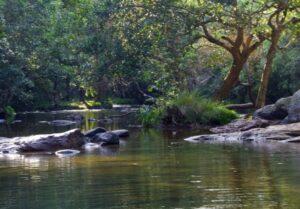
Parassinikkadavu Houseboats – While there was time before the Theyyam began, we turned away from fire and rhythm and moved toward water—letting the day slow, the noise fade, and the backwaters take over where the drums would soon return. Traditional kettuvallam houseboats glided quietly through backwaters—no rush, no spectacle. Bamboo, coir, jackfruit wood. Kerala’s engineering whispered rather than shouted. For the child, this was motion without effort. For us, it was breath after intensity.
Kottayam — Green That Moves
The next day brought a 6–8 hour journey to Kottayam. At dawn, we drove to Illikkal Kallu. Hills rolled like waves frozen mid-motion. Grass bent with the wind as if obeying instructions only it could hear. Small wooden bridges crossed shy streams. Even the tea shop looked painted by a patient artist. Our little explorer crouched, plucked leaves, stared hard – What makes them move? Is there a battery inside? Science begins exactly there.
Vagamon — Cold Air, Warm Nights
Vagamon arrived wrapped in mist and September chill. Light sweaters emerged. Smiles followed. At Beyond Pines, pine forests stretched endlessly. The air felt like nature’s air-conditioning. I cycled briefly — and was immediately chased by a toddler’s cry: joy, fear, attachment—all at once. We cuddled that night, cold outside, warmth stacked layer upon layer inside. Morning brought an authentic Kerala breakfast, and then exploration resumed.
Pine Forests & Meadows – Pine needles fascinated her. She grabbed handfuls and threw them skyward like confetti. Fallen logs became horses. Meadows became kingdoms. My parents found a log and rested. We ran. We laughed. We flew a kite bought from a roadside vendor – watching it dance in unfamiliar skies.
Thiruvananthapuram — Where Silence Has Weight
A 4.5-hour drive carried us steadily south, until the landscape shifted and we entered Thiruvananthapuram—The City of Lord Anantha. There was a quiet sense of arrival, as though the journey itself had slowed in reverence.
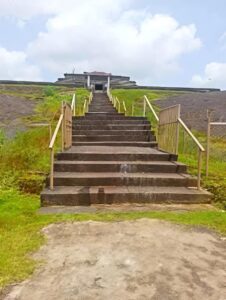
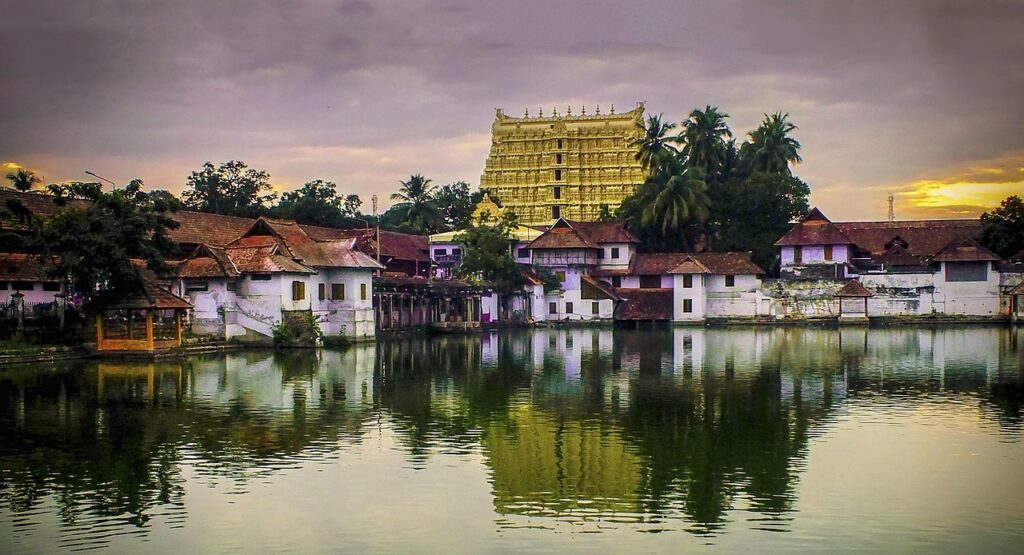
Padmanabhaswamy Temple – Padmanabhaswamy Temple does not overwhelm you at the gate. It does something far subtler. Vaikunta doesn’t announce itself—it settles into you. Phones were deposited. Chappals left behind. Conversations softened. Ahead stood the golden gopuram, luminous and still. My daughter, determined and unbothered by scale, chose to climb the steps on her own—almost crawling, each step larger than her tiny stride, yet conquered one by one. When we finally stood before Anantha Sayana Vishnu, time seemed to pause. The vastness of the reclining form, seen through the sacred doors, felt both immense and intimate. It was impossible not to be moved. Tears streamed down my father’s face. I had never seen him like that—eyes filled with gratitude, fulfilment, and a depth of bhakti so intense it felt tangible in the air. It was as though a lifelong wish had quietly found its completion. I stood there equally stunned—by the scale of the deity, the realism of the form, and the sheer impossibility of having such divinity rendered so powerfully. We stepped out of the sanctum lighter, quieter, and deeply at peace.
At Attukal Bhagavathy Temple, the mood shifted to celebration. Music filled the space, and little feet instinctively danced along, absorbing devotion through rhythm and movement rather than ritual. The Napier Museum offered a gentler pause. History rested quietly behind glass—bronze idols, carvings, and artefacts telling stories without urgency, inviting observation rather than awe.
At the Thiruvananthapuram Zoo, something subtle yet significant unfolded. This was my daughter’s second encounter with animals, and the difference was unmistakable. There was less shock and far more recognition. Curiosity replaced hesitation. Animals were no longer pictures from books or screens—they were living beings, worthy of attention and time. She walked ahead with quiet confidence, choosing where to pause and what to watch.
Aazhimala and Kovalam – As evening approached, we visited the Aazhimala Shiva Temple. Shiva rose against the open sea—not symbolic, not stylized, but strikingly alive. The statue’s realism, the precision of its carving, and the endless horizon behind it created a powerful stillness. We lingered there until darkness slowly claimed the sky, accompanied by a steady sea breeze.
The day ended at Kovalam Beach. Dinner was simple and unhurried—waves breaking nearby, dim lights reflecting off the water, and long stretches of comfortable silence between conversations. It was a fitting close to a day shaped by devotion, discovery, and quiet awe.
Kanyakumari — Where Land Ends and Stories Begin
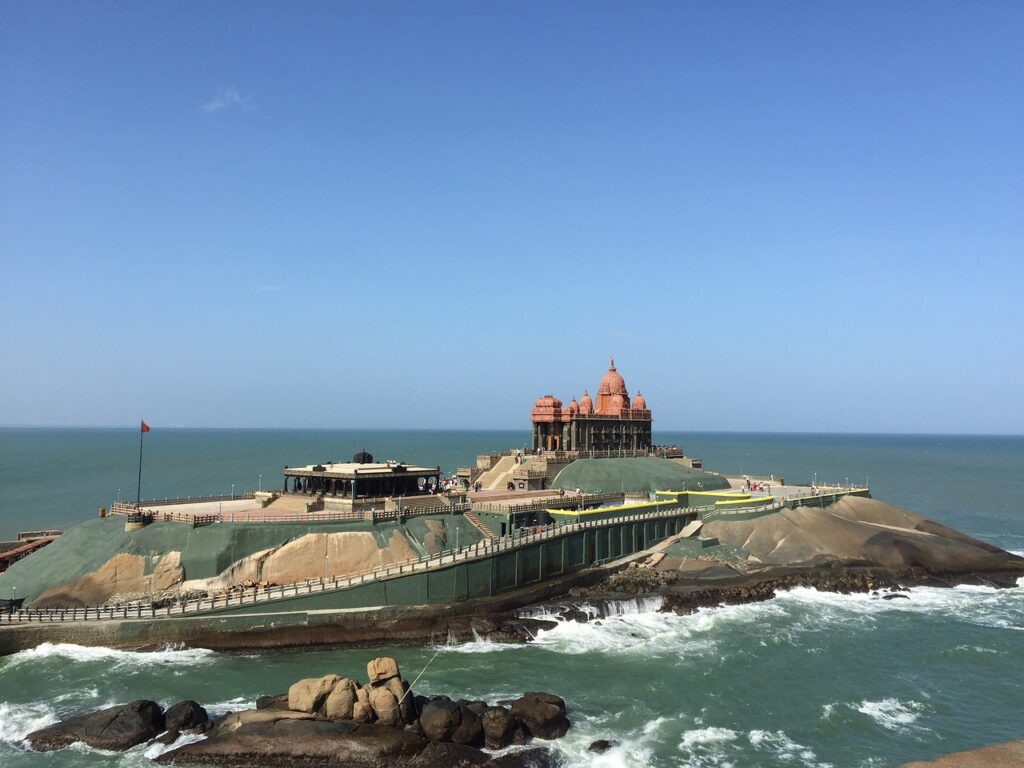
Kanyakumari greeted us gently, almost unexpectedly so. The weather was pleasant—far kinder than we had imagined for the tip of the country—and the pace of the town felt unhurried, as though land and sea had agreed to slow everything down. At the Triveni Sangam, we stepped into the sacred waters where the Arabian Sea, the Bay of Bengal, and the Indian Ocean meet. The dip felt symbolic—less about ritual and more about arrival. Standing there, with waves brushing past our feet, it was impossible not to feel the weight of geography and belief converging in one place. A ferry ride followed, carrying us across open waters to the Vivekananda Rock Memorial. Known historically as Shripada Parai, the rock holds deep spiritual significance, believed to bear the footprint of Goddess Kanyakumari, where she performed intense tapas. It was also here that Swami Vivekananda meditated for three days and nights—an experience that went on to shape his vision for India and the world. Walking through the Dhyana Mandapam and the surrounding halls, the stillness felt deliberate, as though silence itself was part of the architecture.
At the shoreline, we arrived at Arulmigu Devi Kanyakumari Bhagavati Amman Temple, where faith meets the sea without any attempt at separation. The Devi stood radiant and unmistakably present. The stories were true—the tiny nose stud caught the light and burned like a star, flashing with every movement of the lamp, giving the idol an unsettling, beautiful sense of life. It was the kind of moment that makes you pause, unsure whether you are witnessing ornamentation or something far more aware.
From there, we moved on to the Kanniyakumari Shri Tirupathi Temple. Perched with an open view of the ocean, the temple offered blessings of Venkataramana against a vast blue backdrop. The contrast was striking—structured devotion framed by endless water—quietly reinforcing the idea that belief, like the sea, has no edges.
The journey then took us to the Ramayana Darshanam and the Bharat Mata Mandir. Here, mythology and nationhood unfolded side by side. My parents and nephew moved through the exhibits with visible excitement, absorbing the narratives with familiarity and pride. Our little one, however, engaged with it in her own way. She didn’t grasp the stories or the symbolism, but she pointed, looked up, and softly said “Doja”—her word for God. In that single syllable, the essence of the place found its simplest expression.
Museums followed, including the playful detour into the Mayapuri Wonder Wax Museum, where posing beside a wax version of Johnny Depp from Pirates of the Caribbean brought unexpected laughter and lightness to the day.
We checked into Sparsa Hotel, where the ocean felt close enough to be part of the room. The afternoon slowed naturally, and rest came easily. Later, the swimming pool became the setting for a small but memorable milestone. For our daughter, it was her first true pool experience—complete with her trusted swim ring, a cozy bathrobe afterward, and a newfound confidence that showed in every fearless splash. She moved through it all with the assurance of someone discovering a new element and claiming it as her own.
As evening approached, we made our way to sunset point. Watching the sun descend at the tip of India, with endless water stretching in every direction, felt like a quiet conclusion—not just to the day, but to the entire journey. There was no rush to speak, no need to document the moment. The chapter closed naturally, carried out by the light fading into the sea.
The Long Way Back
We returned the way we had begun—by train. The luggage was heavier, the pace slower, and the conversations softer. There was a quiet tiredness among us, the kind that comes not from exhaustion alone, but from having taken in too much to process all at once.
My parents were visibly content. This was not the way they had travelled before—not across so many places, not with pauses that allowed experience to settle rather than rush past. There was satisfaction in that realization.
And somewhere between stations and sleep, it became clear that the journey had been gently led by the youngest among us. A two-year-old, unaware of routes or rituals, had carried us across temples and hill stations, water and history, devotion and discovery. There were no maps to follow, no rigid plans to protect—only curiosity, presence, and an unquestioning trust in movement itself.
Sometimes, it turns out, that is exactly how a journey is meant to be made.
The Two-Year-Old Survival Kit : Pack for resilience, not perfection
Clothing
Pack light, but pack smart.
Daily outfits by count, plus three spares for spills and sudden weather changes. One warm layer, socks that won’t disappear, comfortable shoes, and a backup pair that never sees daylight unless everything goes wrong.
Food & Water
Familiar snacks. Always familiar snacks.
A sipper, a bottle if needed, a small bowl and spoon. Hunger causes more breakdowns than fatigue.
Hygiene
Diapers with margin. Wipes without compromise.
A changing mat, rash cream, sanitizer, and a towel that dries fast and forgives mistakes.
Medical
This is non-negotiable.
Fever medicine, ORS, basic cold remedies, thermometer, mosquito protection, sunscreen, and one clear note with the pediatrician’s number.
Travel-Day Bag
This never leaves your side.
One full outfit, diapers, wipes, snacks, water, a comfort toy, and plastic bags for damage control.
Sleep & Comfort
One object that smells like home.
A blanket, a soft toy, something familiar enough to convince the mind that this strange bed is safe.
Entertainment
Small, quiet, effective.
A book, crayons, stickers, one toy that survives drops. Offline videos only if negotiations fail.
Footwear & Outings
Easy on. Easy off.
Extra socks, cap, sunscreen. Sand and water will happen whether you plan for them or not.